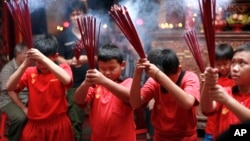
Indonesian ethnic Chinese children pray at a temple in the China Town in Jakarta, Indonesia, January 7, 2012.
Chinese Indonesians, Muslims Ring in the New Year
JAKARTA —
For Indonesians of Chinese descent, the freedom to practice their cultural traditions is still relatively new. However, in the main cities across Indonesia, towns were painted red to mark the Chinese New Year. But not all Chinese Indonesians say they can practice their beliefs openly.
The Islamic call to prayer is not what you would typically associate with Chinese New Year. But for a small population of Chinese Indonesians, the Year of the Snake was celebrated in Islamic style at the mosque.
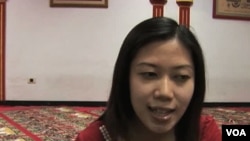
“This is my first time celebrating Chinese New Year in a mosque," said 27-year-old Cung Li Ha. "Because I just turned mulaaf, or I just declared myself into a Muslim just last year, September this year.”
As part of Indonesia’s Chinese minority, her choice of religion makes her somewhat of an anomaly in the Muslim-majority nation.
Of Indonesia’s population of 240 million, about nine million are diasporic Chinese - most are adherents of Buddhism, Christianity and Confucianism. Very few have converted to Islam.
Cung Li
Cung Li says there are still big challenges. This morning, for example, she had to lie to her family about where she was going. “It’s very difficult because most Chinese families still cannot accept that their children or their families change into a Muslim they are usually more open to Christianity,” Cung stated.
During the three decades of the Suharto dictatorship, the language and cultural traditions of Chinese Indonesians was suppressed.
For the past decade, Chinese Indonesians have freely celebrated Imlek, the local word for Chinese New Year, with elaborate festivities.
In Jakarta, huge Chinese dragons hang suspended from the shopping malls and in the temples dotted around the city, thousands of prayers are whispered over incense sticks.
But the Muslim Chinese are less flamboyant.
Within the Chinese Indonesian community there is a perception that Muslim Chinese have forfeited their heritage and are no longer Chinese.
However, those at Jakarta’s Lautze Mosque beg to differ.
Ali Karim was raised a Chinese Muslim and says it is important to differentiate tradition from religion.
Karim says that most Chinese Indonesians believe that Imlek is not a religious ceremony, but rather something like New Year’s Eve. Culture, he says, is not the same as religion.
Lautze Mosque is the only mosque in the sprawling metropolis of Jakarta that is distinctly Chinese.
Rather than a traditional domed roof skirted by turrets, crimson lanterns hang above the arched entranceway.
Inside, ancient Chinese calligraphy - the words of the Prophet Mohammed - hang on the walls, and the mecca-print prayer rugs are bright red.
Forty Six-year-old Mudhi Astuti says she feels at home at Lautze Mosque, even though she is not Chinese. “When I come to Lautze it is like my home. Frankly speaking this is not only a unique mosque, our heart is here because when many Chinese friends come here and be a mulaaf and everyone has no family anymore, no job, no money," Astuti stated. "Not only do we love together, but we cry together.”
Mudhi says that of the roughly 1,000 Chinese who have converted to Islam at the Lautze mosque, most have been rejected by their families.
Some even leave their partners and children to follow Islam.
But time heals, she says, and sometimes after several years they re-establish good relationships with their families.
It is a delicate challenge that the newly converted Cung Li is still trying to navigate with her family.
She says she worries they might not accept her new religion but, so far, the New Year celebrations are not that different. “I guess it is the same thing, I just didn’t go and say and prayer and chanting to the table full on the ancestors names. It’s just I didn’t do that and I try not to eat pork," Cung explained. "But I still eat the cake that my mum made and the noodles but the other than that I tried not to touch anything.”
In this new year of the water snake, Cung Li she hopes to build the courage to tell her parents she has converted to Islam.
Even though, she admits, they probably already know.